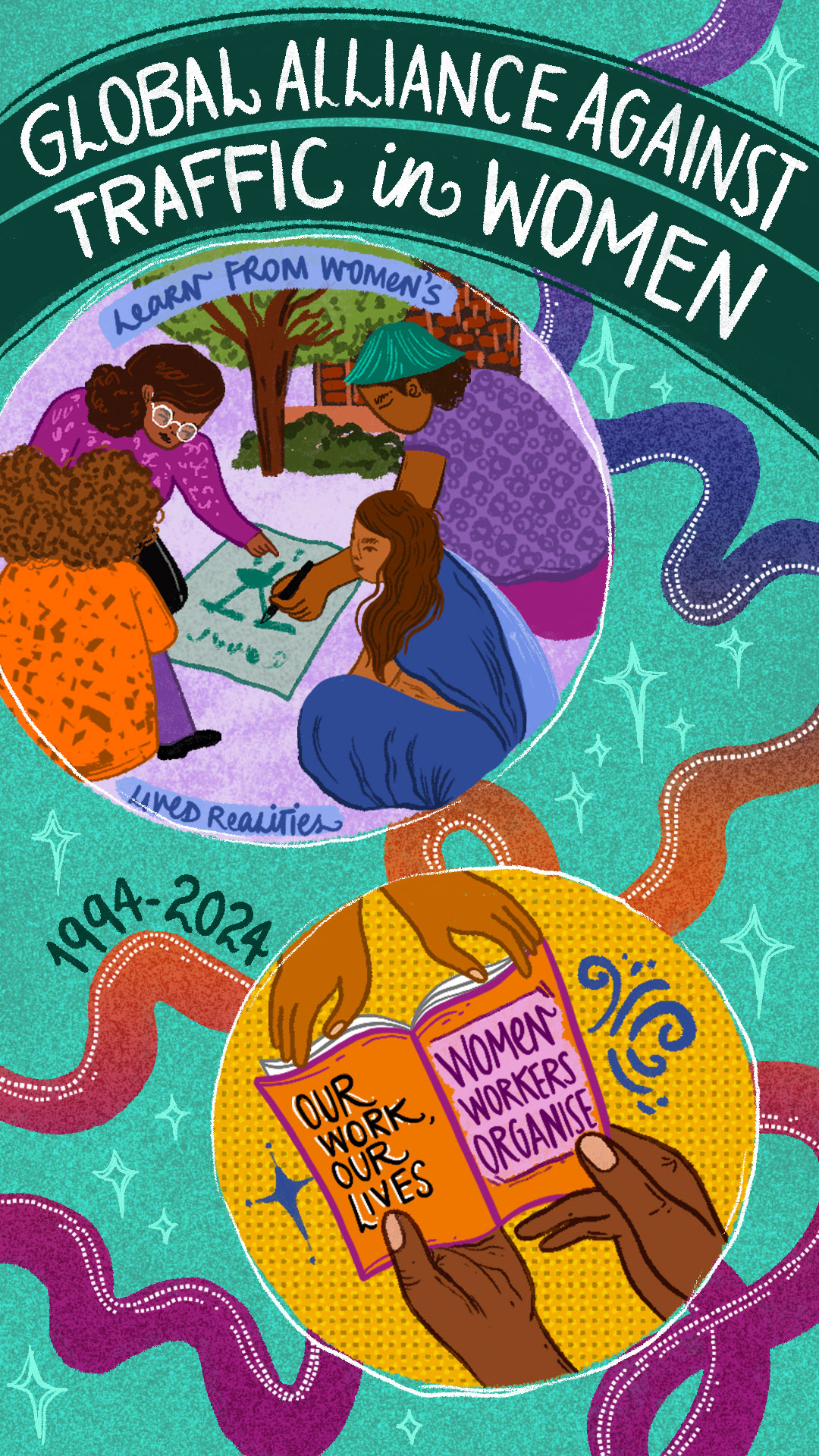
Global Alliance Against Traffic in Women

GAATW sees the phenomenon of human trafficking as intrinsically embedded in the context of migration for the purpose of labour.

Global Alliance Against Traffic in Women

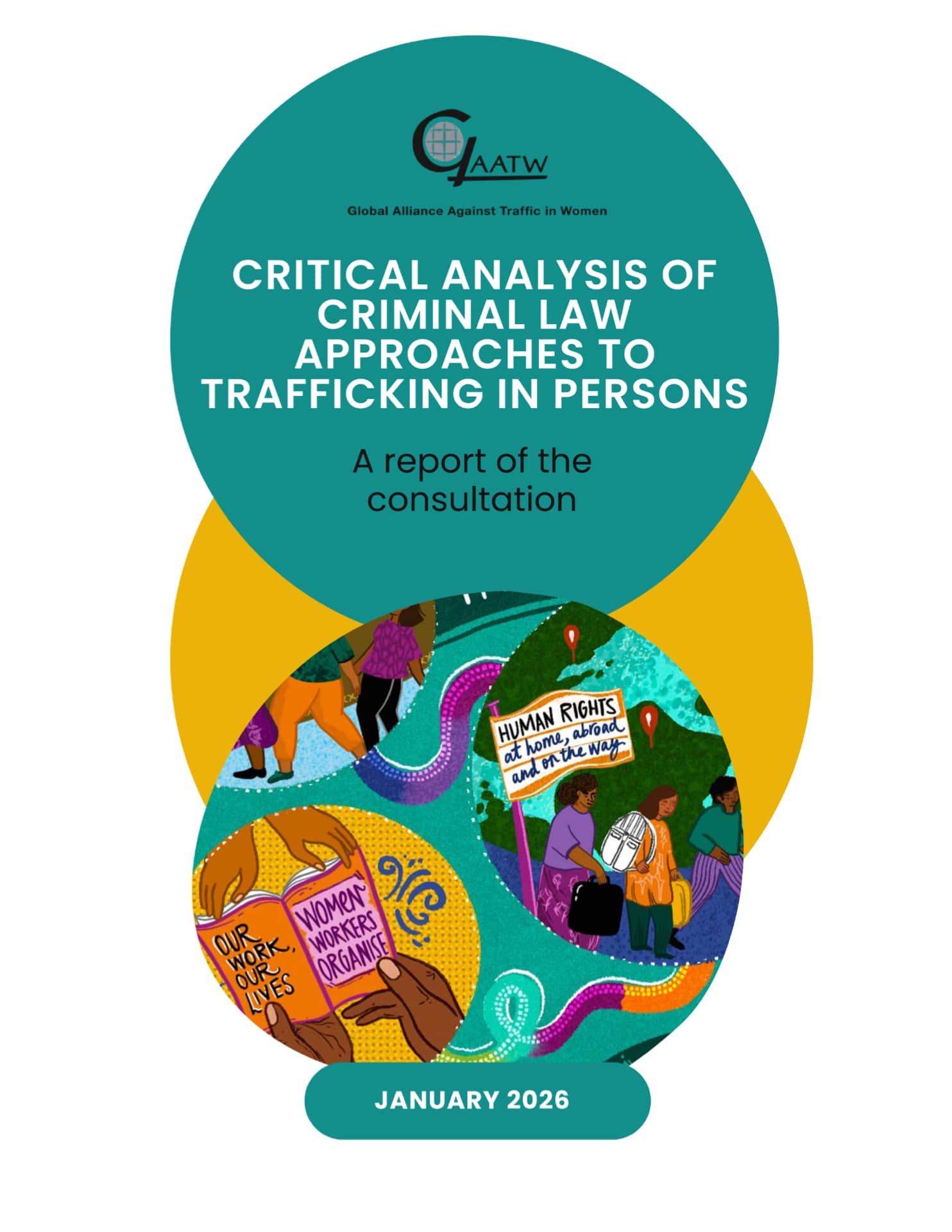
Critical Analysis of Criminal Law Approaches to Trafficking in Persons: A report of the consultation

GAATW and our allies played a key role in lobbying for an internationally recognised definition of trafficking, yet from the outset we were wary of an exclusively crime control approach. Over the years, we have continued to note with frustration that although the criminal law framework is so invested in punishing the traffickers, the actual results of those efforts are not very encouraging.

Now twenty-five years after the UN Trafficking Protocol entered into force, it is an appropriate time for us to reflect in depth on the criminal law approach to trafficking. Whilst GAATW has long pointed out the negative impacts of this approach, we have not looked outside the criminal law or questioned what alternatives might exist.

Read more

Critical Analysis of Criminal Law Approaches to Trafficking in Persons: A report of the consultation

GAATW and our allies played a key role in lobbying for an internationally recognised definition of trafficking, yet from the outset we were wary of an exclusively crime control approach. Over the years, we have continued to note with frustration that although the criminal law framework is so invested in punishing the traffickers, the actual results of those efforts are not very encouraging.

Now twenty-five years after the UN Trafficking Protocol entered into force, it is an appropriate time for us to reflect in depth on the criminal law approach to trafficking. Whilst GAATW has long pointed out the negative impacts of this approach, we have not looked outside the criminal law or questioned what alternatives might exist.

Read more

Crisis in Care: Migrant Workers and Ageing Societies in Japan and South Korea

As more and more countries confront the challenges posed by ageing populations and evolving family structures, there is an increasing reliance on migrant workers to fill essential roles within the care sector. However, state programs often categorise this form of labour as low-skilled and temporary, providing limited labour protections and exacerbating the precariousness faced by migrant workers.  

This working paper examines how care work is defined, structured, and governed in Japan and South Korea, and how these frameworks shape the experiences of migrant care workers. It unpacks the demographics driving the demand, the policies and pathways governing migrant labour for care work, and the difficult working conditions that result from the devaluation of care. It also emphasises the crucial role of civil society in offering support and broadening its advocacy for migrant rights. 

Read more

Crisis in Care: Migrant Workers and Ageing Societies in Japan and South Korea

As more and more countries confront the challenges posed by ageing populations and evolving family structures, there is an increasing reliance on migrant workers to fill essential roles within the care sector. However, state programs often categorise this form of labour as low-skilled and temporary, providing limited labour protections and exacerbating the precariousness faced by migrant workers.  

This working paper examines how care work is defined, structured, and governed in Japan and South Korea, and how these frameworks shape the experiences of migrant care workers. It unpacks the demographics driving the demand, the policies and pathways governing migrant labour for care work, and the difficult working conditions that result from the devaluation of care. It also emphasises the crucial role of civil society in offering support and broadening its advocacy for migrant rights. 

Read more

GAATW Statement for the Conference of Parties of the UNFCCC (COP 30) on 10-21 November 2025

COP 30 comes at a time of increasing global injustices. Genocide, escalating and unmet humanitarian needs from conflict and climate change, and persistent economic inequality are among them. We also face serious challenges to multilateralism, and the willingness of Global North countries to take their fair share of climate responsibility. However, COP being held in Brazil this year creates a sense of hope that backsliding on climate ambition can be stopped and reversed. Turning words into action for migrants and displaced people affected by climate change is a critical component of achieving a meaningful outcome in Belém.

Read more

GAATW Statement for the Conference of Parties of the UNFCCC (COP 30) on 10-21 November 2025

COP 30 comes at a time of increasing global injustices. Genocide, escalating and unmet humanitarian needs from conflict and climate change, and persistent economic inequality are among them. We also face serious challenges to multilateralism, and the willingness of Global North countries to take their fair share of climate responsibility. However, COP being held in Brazil this year creates a sense of hope that backsliding on climate ambition can be stopped and reversed. Turning words into action for migrants and displaced people affected by climate change is a critical component of achieving a meaningful outcome in Belém.

Read more

Durbar Mahila Samanwaya Committee is a forum of 65 000 sex workers based in West Bengal, India. The basic approach of Durbar’s programme is based on the principle of “3 R’s” - Respect, Reliance and Recognition: Respect towards sex workers, Reliance on the knowledge and wisdom of the community of sex workers and Recognition of sex work as an occupation, for the protection of their occupational and human rights. Durbar was created by sex workers involved in the STD/HIV Intervention Programme or the Sonagachi Project. In 1999, Durbar took over the management of the Sonagachi Project and currently runs STD/HIV intervention programmes in 49 sex work sites in West Bengal. Durbar provides testing, counselling and care for people with HIV/AIDS. DMSC’s anti-trafficking work is done through Self-Regulatory Boards comprised of both sex workers and community supporters. Self-Regulatory Boards monitor brothels in co-operation with brothel owners in order to identify women and children who have been trafficked and to arrange for care. DMSC has also created a hostel for sex workers children, worked to decrease violence and abuse by law enforcement agencies, implemented an initiative to admit children in schools, organised loan programmes, provided vocational training for the children of sex workers (as electricians and beauticians), created the Usha Multi-Purpose Cooperative Society (the largest cooperative society for sex workers in Asia), provided literacy training for adults, organized annual conferences for sex workers, established Komol Gandhar (sex workers performance troupe) and the Binodini Srameek Union or the Binodini Labour Union. 

Contact Details:
Address: 12/5 Nilmoni Mitra Street, Kolkata, West Bengal, India
Tel: +91 33 2530 3148
Email: This email address is being protected from spambots. You need JavaScript enabled to view it.
Website: durbar.org

Resources

Publications

Feminist Knowledge Building

Statements

Advocacy and Influencing

Multimedia

Strategic Communications

Join our Call for Papers for the bi-annual Anti-Trafficking Review Journal, write to atr@gaatw.org
Get the latest updates from GAATW-IS and our members by subscribing to our E-Bulletin!
Follow us on social media              
get involved get involved

© 2026 GAATW. All Rights Reserved.