Global Alliance Against Traffic in Women

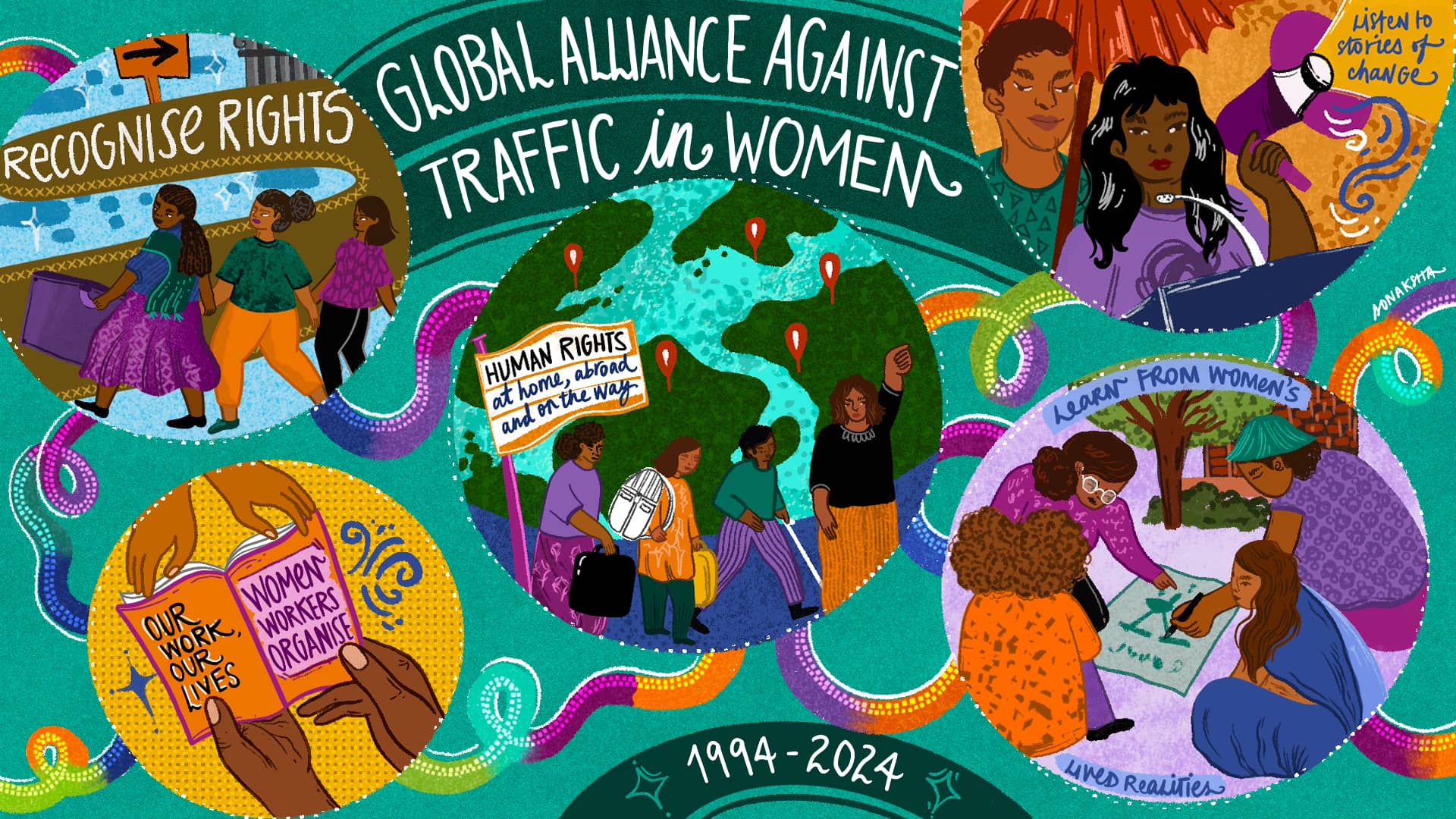
GAATW sees the phenomenon of human trafficking as intrinsically embedded in the context of migration for the purpose of labour.

Global Alliance Against Traffic in Women

Learning Brief: Who Gets to Tell the Story? Community-Led Media and Knowledge for Advocacy and Narrative Change

This learning brief is part of GAATW's Learning Circle series, peer-learning spaces where our members come together to share their practices, learn from one another and reflect on common challenges in their work. It brings together the reflections and discussions from our Fourth Learning Circle, where members explored how community-led storytelling, participatory research and other ways of producing knowledge can strengthen advocacy and influence from the ground up.

Read more

Learning Brief: Who Gets to Tell the Story? Community-Led Media and Knowledge for Advocacy and Narrative Change

This learning brief is part of GAATW's Learning Circle series, peer-learning spaces where our members come together to share their practices, learn from one another and reflect on common challenges in their work. It brings together the reflections and discussions from our Fourth Learning Circle, where members explored how community-led storytelling, participatory research and other ways of producing knowledge can strengthen advocacy and influence from the ground up.

Read more

From Punishment to Protection (of rights): A feminist analysis of trafficking for forced criminality in the ASEAN region

Trafficking for forced criminality has historically received less attention from international institutions, the media and the human rights sector. However, awareness of this form of trafficking is increasing globally. This briefing paper aims to support that growing recognition by examining how trafficking for forced criminality is occurring within the Association of South East Asian Nations (ASEAN) region.

Read more

From Punishment to Protection (of rights): A feminist analysis of trafficking for forced criminality in the ASEAN region

Trafficking for forced criminality has historically received less attention from international institutions, the media and the human rights sector. However, awareness of this form of trafficking is increasing globally. This briefing paper aims to support that growing recognition by examining how trafficking for forced criminality is occurring within the Association of South East Asian Nations (ASEAN) region.

Read more

Trafficking for Forced Criminality in Europe: Protection Gaps in an Era of Restrictive Migration Policy

This report is published at a time when punitive approaches to migration, crime and border control are increasing across Europe. For years, victims of trafficking for forced criminality have been  treated as offenders or ‘illegal immigrants’ rather than as rights holders who have experienced exploitation and coercion. Despite growing recognition of the scale and severity of trafficking for forced criminality across Europe,  institutional responses continue to fail at effective prevention, identification and protection. Whilst some governments in the last decade have introduced specific laws designed to protect victims of trafficking from punishment for the crimes they were forced to commit, the majority of these laws fall short of international standards, or are inconsistently implemented.

Read more

Trafficking for Forced Criminality in Europe: Protection Gaps in an Era of Restrictive Migration Policy

This report is published at a time when punitive approaches to migration, crime and border control are increasing across Europe. For years, victims of trafficking for forced criminality have been  treated as offenders or ‘illegal immigrants’ rather than as rights holders who have experienced exploitation and coercion. Despite growing recognition of the scale and severity of trafficking for forced criminality across Europe,  institutional responses continue to fail at effective prevention, identification and protection. Whilst some governments in the last decade have introduced specific laws designed to protect victims of trafficking from punishment for the crimes they were forced to commit, the majority of these laws fall short of international standards, or are inconsistently implemented.

Read more

Brigada Callejera (Brigada Callejera de Apoyo a la Mujer “Elisa Martínez”) is a non-governmental organisation that has been working with sex workers in Mexico since 1995. Brigada offers education and many other services to help sex workers find dignity in their work, and develop the skills to find other work. Brigada specialises in the defence of human rights and labour rights of sex workers.

Brigada Callejera helps sex workers form cooperatives and gain access to medical care, while distributing condoms and working to prevent the spread of HIV/AIDS. Brigada also has a "board" (patronage) and "outside counsel" made ​​up of specialists in health, public policy and journalism. One of its objectives is to promote community mobilisation of sex workers, its customers and partners against trafficking for sexual exploitation.

Contact Details:
Address: Calle Corregidora 115-204, Col. Zona Centro, del. Venustiano Carranza, Distrito Federal, México 15100
Tel: +52 55 55427835
Email: This email address is being protected from spambots. You need JavaScript enabled to view it. This email address is being protected from spambots. You need JavaScript enabled to view it.
Website: http://www.brigadaac.mayfirst.org 
Facebook: facebook.com/brigadacallejera
Resources

Publications

Feminist Knowledge Building

Statements

Advocacy and Influencing

Multimedia

Strategic Communications

Join our Call for Papers for the bi-annual Anti-Trafficking Review Journal, write to atr@gaatw.org
Get the latest updates from GAATW-IS and our members by subscribing to our E-Bulletin!
Follow us on social media              
get involved get involved

© 2026 GAATW. All Rights Reserved.