
Interview with Liana, Director of Manuwani Indonesia by Dewi Nova
|
|
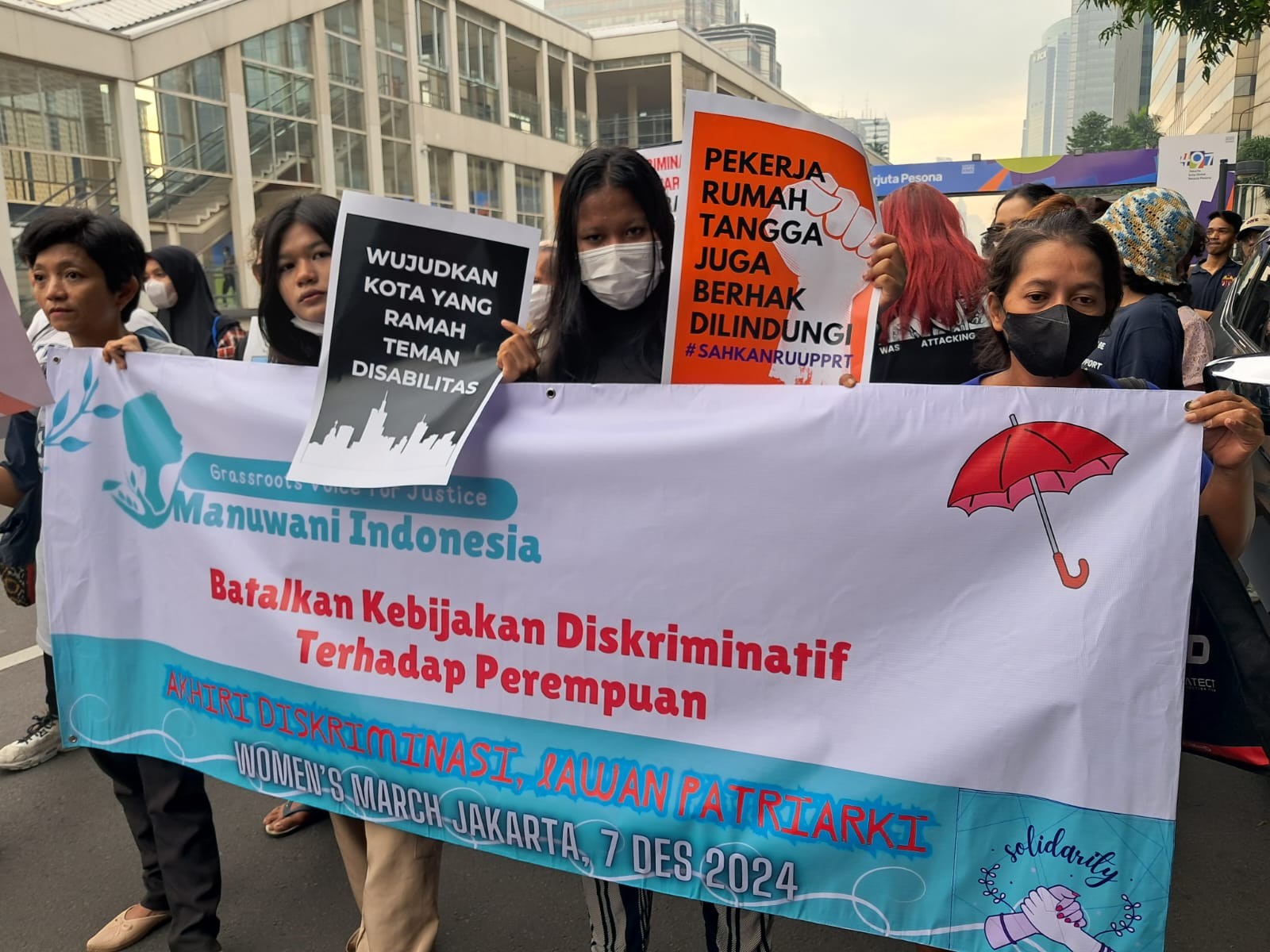 Manuwani joined the women's movement in taking action at the Women's March on 7 December 2024 in Jakarta - calling on the Indonesian government to abolish discriminatory policies.
This short interview was conducted in commemoration of International Sex Workers Day, celebrated every June 2nd.
Manuwani Indonesia is a sex worker organisation currently organising street sex workers in East Jakarta and sex workers in harbour cafes in North Jakarta, Indonesia.
Can you start by explaining why it is important for sex workers to organise?
Sex workers are people who have a profession – providing sexual services. Therefore, sex work is work. Everyone works to earn money to support their families, and sex workers are no different.
Women, in patriarchal cultures like Indonesia, are consistently left behind. This disadvantage is even worse for marginalised women, such as women sex workers. Women sex workers have unique experiences compared to other sex workers. This is because:
First, before choosing to become sex workers, women have less access to education than men. In poor families with limited resources to send their children to school, girls are often forced to give way to boys, who are given priority in education. This early discrimination prevents women from accessing many jobs as men. Even when women and men both work as sex workers, they are placed in different classes. Men with higher levels of education can become sex workers with better incomes. This situation is inversely proportional to women sex workers, who are mostly sex workers with very low incomes.
Second, the identities of male sex workers tend to be protected. They don't face the stigma of being bad men that women sex workers face. This contrasts with how gender constructs view women. For women, even going out at night or working in a cafe can result in being stigmatised as sex workers, meaning they're bad women.
Third, women sex workers are more likely to be burdened with reproductive and domestic duties. In the Manuwani community, 80% of women sex workers are the breadwinners of their families—they are single, divorced, or their partners are unable to support them and their families. However, these breadwinners still have to fulfill their reproductive roles and domestic responsibilities at home.
This situation also makes it difficult for women sex workers to organise themselves due to their heavy workload and limited free time. This contrasts with male sex workers, who have greater privileges.
Many transgender sex workers were forced to, or chose to, leave home at a young age. Whilst this causes many of them a lot of suffering, it has also freed some of them from domestic roles and burdens that cis women sex workers are facing.
What are the fundamental problems faced by women sex workers and how is Manuwani trying to make changes?
Everyone asks why women become sex workers. The answer is undoubtedly economic pressure. This is the reality. Women must support their children. This economic hardship results in a variety of problems. Due to their weak economy, they lack access to healthcare. For lower-middle-class women, the current economic hardship is a real blow. A decline in society’s income means a decline in the number of sex workers’ customers, and many women sex workers are now unable to pay their rent.
Economic hardship impacts their homes and health issues. Manuwani organises women sex workers who are excluded from NGO programmes. It's a shocking fact that even after decades of HIV/AIDS prevention programs, many women sex workers still lack access to healthcare. This includes public health services facilitated by the state. Many women sex workers have not accessed BPJS Kesehatan (Health Protection) because they lack identity cards or are not yet old enough to obtain an ID card, which is only for people over 18. Even though the state provides state-funded health coverage, their identity as sex workers often hinders access to these programmes for the poor.
Economic hardship also leaves them behind in digital advancements. While many people feel their lives have been greatly improved by internet technology, these workers are the ones who can't even afford smartphones. If this economic situation does not change, women sex workers will be in this cycle of problems continuously.
Second, they struggle to find space to talk, to express their "this is my wish, this is my need." They also don't have time for heart-to-heart talks with people they trust because they're too tired. They work nights and come home in the morning still having to get their children ready for school.
Through discussions with fellow sex workers, they agreed to gradually address this issue in two ways:
- First, develop a collective business unit. This idea is based on their initial skills as small-scale traders, particularly among older sex workers. We will develop this business unit into a movement ecosystem. For example, if an NGO needs food, they can order food from this business unit, as well as snacks and crafts. So, we are developing a business chain to increase the income of women sex workers.
- Second, creating liberation theater. Performing theater with this participatory approach helps women sex workers voice their experiences and perspectives on life. We learned that they are the backbone of their families, with various experiences of violence, some having a history of trafficking before choosing to become sex workers. They carry all of their life's suffering alone. Performing theater empowers them to release the burdens that traumatise them and brings together other sex workers, creating a supportive collective.
What should the government do?
Please treat women sex workers as human beings with the same rights as other citizens. When a woman struggles to support her family, the government is obligated to protect her, not arrest and place these women, the breadwinners, in rehabilitation centers, which only adds to the problems faced by sex workers. When the government rehabilitates women sex workers for six months in social institutions, who will feed their children at home? Ultimately, their children are neglected. Ultimately, these women sex workers end up in debt to loan sharks and continue to exploit them until they are released from the rehabilitation center. If the government cannot provide adequate employment, please protect those of us who work hard to support our families.
We are not criminals, so don't treat us unfairly. Please recognise and protect sex workers as workers. When we are recognised as workers, we have bargaining power, can work more safely—we can negotiate with clients to use condoms—this helps limit the spread of HIV. When we experience violence, we can report it to the police without discrimination or even rejection.
Government efforts to shift sex workers' professions, without further marketing support for their non-sexual services, have also failed to meet their needs. Ultimately, women return to sex work, which can better meet their economic needs.
What does International Sex Workers Day mean to you?
International Sex Workers Day is a shared struggle by all sex workers worldwide. We demand that the state grant sex workers their rights and fulfill its responsibility to respect and recognise sex workers, ensuring they are free from discrimination both in the world of work and in their daily lives.