
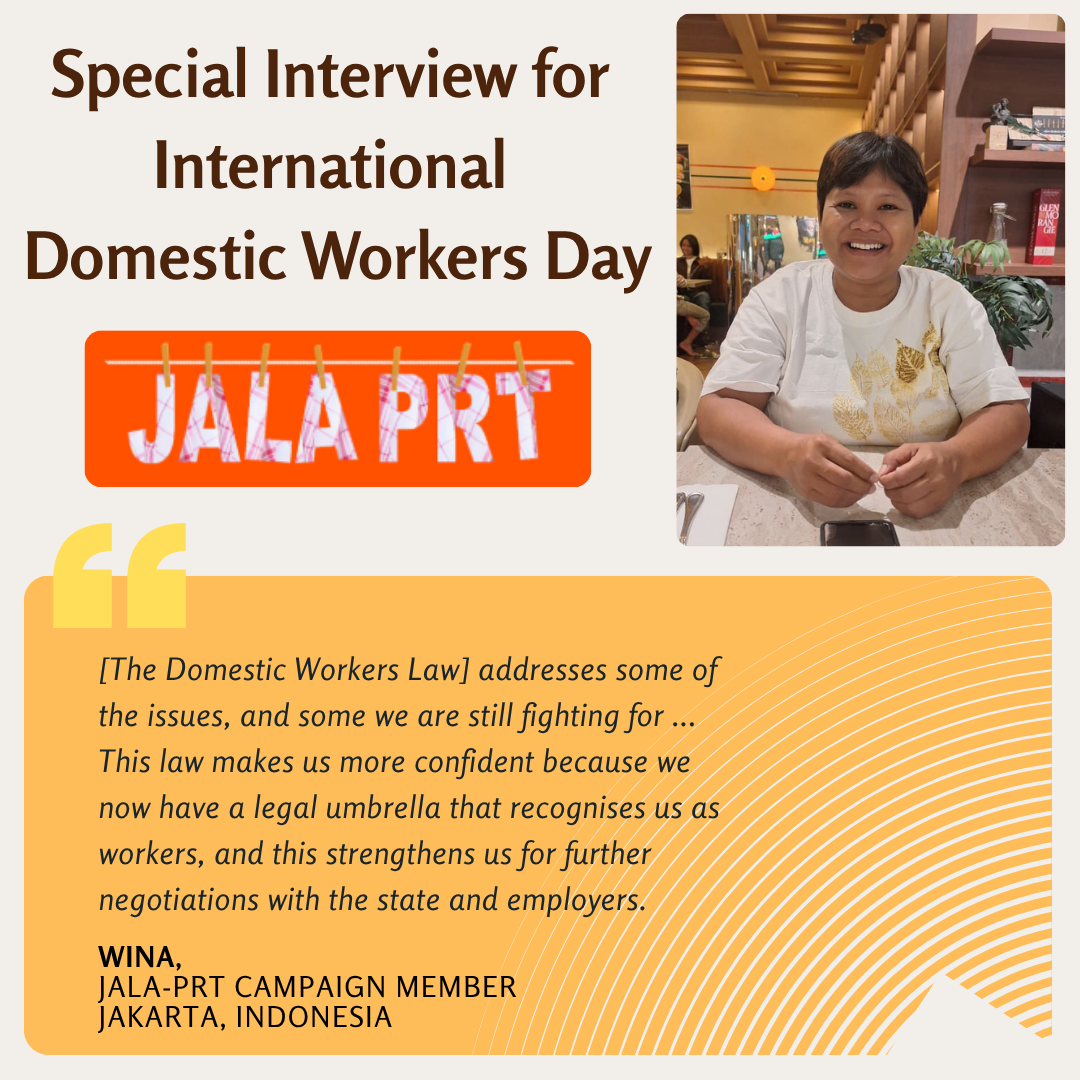
For twenty-two years, JALA PRT (National Domestic Workers Advocacy Network) along with thousands of their domestic worker members and many colleagues from the civil society organisations in Indonesia kept advocating for a specific legislation that would protect the rights of Domestic Workers in the country. Many strategic planning meetings were held. Numerous public actions were undertaken. Countless online campaigns were launched. They even sat in front of the government buildings for days on end. At times they thought that they would achieve their goal within a few days only to be disappointed at the last minute. They felt cheated, fustrated and even angry. It took many internal meetings to keep their hope alive and to keep fighting.
Finally, on 21 April, 2026, Indoensia’s House of Representatives passed the Domestic Workers Protection Law (RUU PPRT).
Why was this law necessary and what would its impact on domestic workers be?
Nova from GAATW-IS spoke with Wina, a domestic worker leader who was part of the long campaign alongside JALA PRT.
The Personal is Political
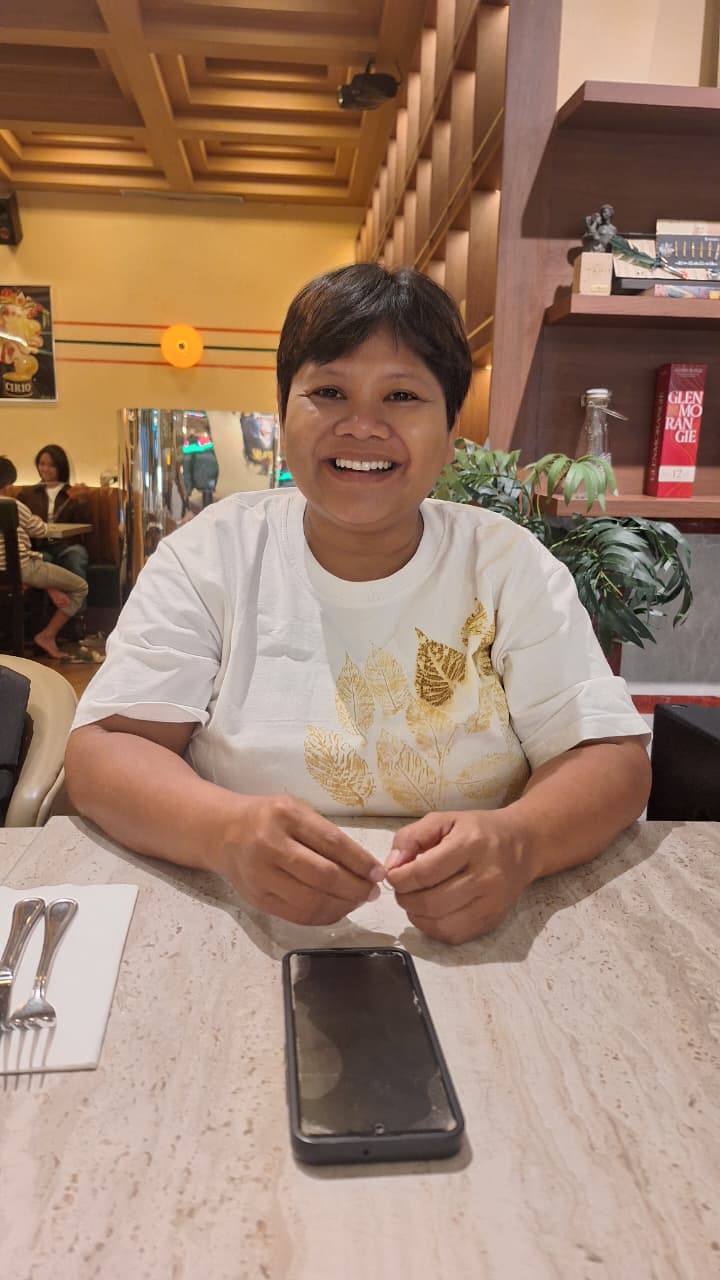
A few words about Wina may help us understand how and why she became part of the struggle. Her story is unique but also typical of many of her peers.
Winaningsih Kuswadi (Wina) was born into a humble family in Cilacap, Central Java. Unable to continue her education beyond junior high school, Wina (then 16 years old) left her hometown to work as a domestic worker in Tasikmalaya, West Java. A year later, she moved to Jakarta and continued working as a domestic worker. In 1999, when she was just 18 years old, Wina decided to migrate to a foreign country for work. An agent helped her with false documentation that increased her age. She travelled with a lot of determination to earn well for her family but without any information on her rights as a migrant domestic worker.
Her employer in Hong Kong turned out to be kind and considerate. They even reminded her to save money for herself. “One day you would get married and start your own family. You will need money for that,” they told her. However, for Wina, just like for many of her friends, the economic needs of their parental families were foremost in their minds and they did not want to be seen as “selfishly thinking about themselves.” It was while in Hong Kong that Wina learnt about the double standards of society towards women. She realised that while ‘good’ women migrant workers were expected to send all their earnings home, they were also stigmaitsed as ‘bad’ women with loose sexual morality. While she was abroad, her mother gave birth to another child, many people in her community gossiped that the baby must be Wina’s biological child from an illicit relationship in Hong Kong. Nevertheless, her hard work in Hong Kong was helping her family. Her parents were able to build a new house with her financial contribution.
After working for a few years in Hong Kong, Wina returned to Jakarta and took up work with an expatriate family. One day, she came to know that a fellow domestic worker friend was laid off by her employers and asked to return the items they had given her. She blogged about it and received a response from an Australian person living in Bali. They gave her the contact details of Lita (founder of JALA PRT, an organisation that advocates for domestic workers' rights) and told Wina to reach out to JALA-PRT if she and her friends had any work related problem. That one initial phone call was a turning point for Wina. She and her friend were invited to a meeting where they met other domestic workers. Soon they became regulars in all the meetings. Asking questions, learning about the law, talking to other domestic workers to collect information, joining campaigns, participating in ILO dialogues and leading delegations became part of her life. Slowly but steadily her political understanding and awareness became deeper and she began to see herself as an intergral part of the social justice movements in Indonesia. As she visited other countries and met other women workers, she got connected to the global struggle for rights and justice. As a member of JALA-PRT’s campaign team, Wina’s role in the advocacy for the Domestic Workers Bill in Indonesia was crucial.
In 2018, Wina began studying law as a member of JALA-PRT’s paralegal team. This year she will join Pamulang University as a law student with a scholarship from JALA PRT. She continues to work as a part-time domestic worker and lives with her partner and children.
In an interview with Dewi Nova, Wina shares her reflections on the new legislation, its implications, and the challenges ahead.
N: As a domestic worker, how did you feel after the Domestic Workers Law was passed?
W: Speechless with joy. I was so happy I was shaking and crying tears of joy. My elusive dream had finally come true! The passing of the Protection of Domestic Workers Law gave me strength. Previously, the law had looked down on me (as a domestic worker), but now I (as a domestic worker) am recognised as a worker.
N: In your opinion, what are the fundamental issues that domestic workers face in Indonesia?
W: Long working hours, low wages, and no breaks. We often find ourselves in situations where, before we even take a break, our employers order us to do something else. It feels like the work never ends.
We often wonder if our employers don't want us to take breaks. Sometimes, even when the cupboards are clean, they still ask us to clean them. Most of us don't dare to refuse this relentless work. Our family ‘culture’ teaches us to be obedient and not to refuse. For example, my parents always advised me to "anticipate the tasks and do those even before your employer asks you to do them.”
I used to think working without rest was normal. After attending the regular learning sessions at the domestic workers’ school at JALA PRT, I understood that I should work according to my employment contract, and not as per my employer's demands or even my parents' advice. Now, I've stopped working excessively long hours just to please my boss. Instead, I work according to the obligations stipulated in my employment contract.
N: Will the problems you mention be solved now that we have a Domestic Workers Law?
W: This law addresses some of the issues, and some we are still fighting for. For example, this law regulates wages for domestic workers but does not yet stipulate a minimum wage. On the positive side, it does state that domestic workers are entitled to rest days.
This law makes us more confident because we now have a legal umbrella that recognises us as workers, and this strengthens us for further negotiations with the state and employers.
N: What do you think will be the challenge in implementing this law?
W: I can see two challenges.
First, it will not be easy to equip domestic workers with the knowledge, awareness, and courage to claim their rights as stipulated in this law. For example, even though this law regulates domestic workers' rights to take leave, do you think many domestic workers will have the courage to discuss this with their employers? Maybe not. This is a new concept in the culture of employing domestic workers in Indonesia. How can they demand their right to take leave without risking anger from their employers or even losing their jobs?
Second, the public, especially employers, often think this law only protects domestic workers, leading them to be antagonistic and unwilling to study it. In fact, this law protects both domestic workers and employers. It actually benefits both parties.With this law, domestic workers can discuss amicably with their employers regarding wages, working hours, rest hours, holidays and request social security rights.
This law also allows employers to know the skills, origin, and health status of domestic workers. Likewise, domestic workers have the right to know the identity of their employers. This is new for us, as we are usually denied to know who our employers are or what their jobs are. But this is necessary for our safety and comfort at work. Employers can also only hire workers with ID cards to prevent the employment of underage.
So, it is important for us to carry out an information campaign regarding the benefits of the Protection of Domestic Workers Law for both parties.
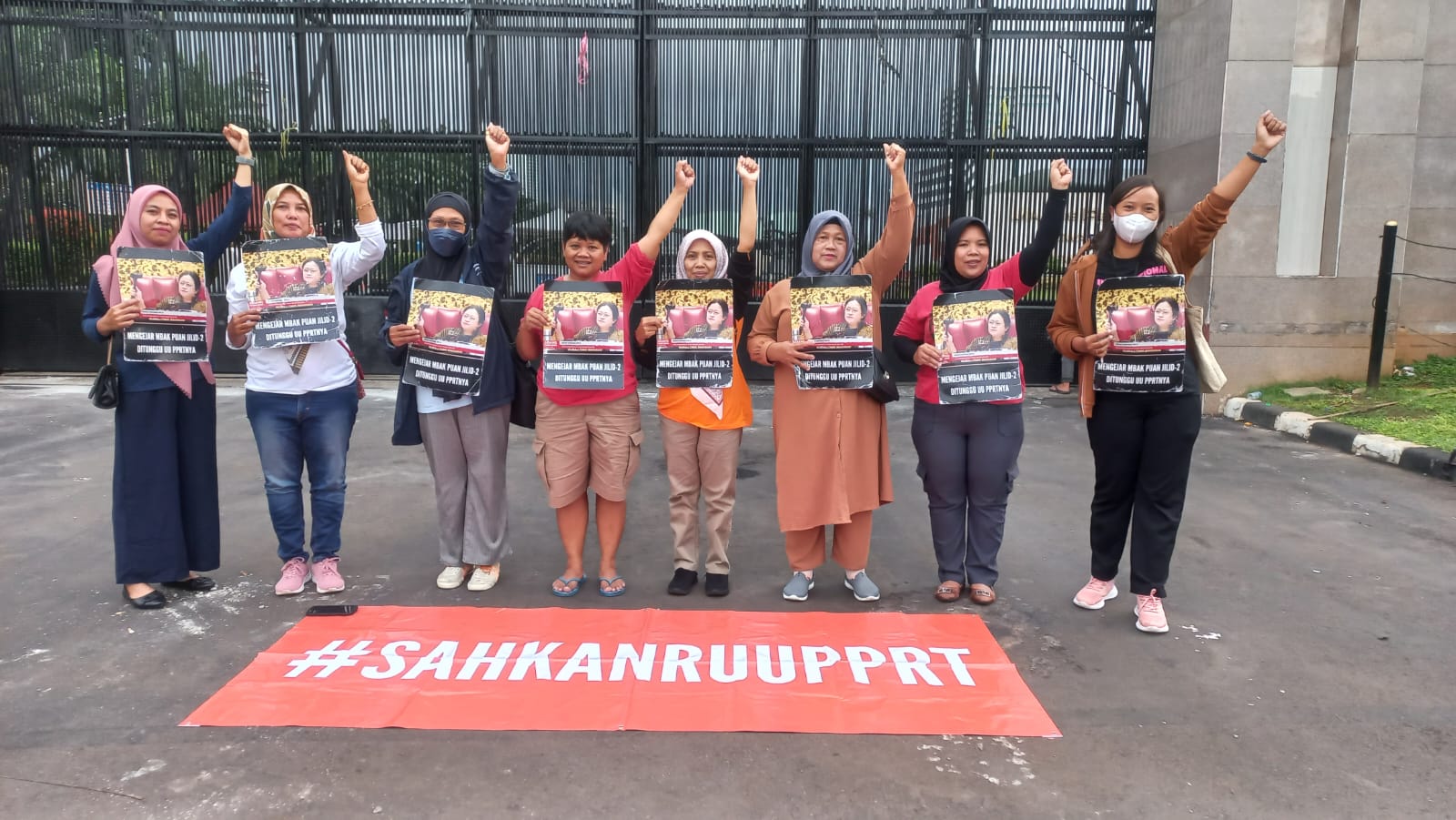 |
| JALA-PRT members protest in front of the House of Representatives. By rotating participation among small groups, domestic workers sustained both their livelihoods and their collective struggle for rights. |
N: What do you think are the gaps in this law?
W: There are several rights that are not yet fully guaranteed in the law, and we will advocate for them in the drafting of Government Regulations for this law. These include wages. The law mentions wages for domestic workers, but does not spell out a minimum wage. How can domestic workers negotiate their salaries with their employers? On what grounds?
Then, regarding health insurance and social security: The new law mandates employers to provide social protection to domestic workers. However, BPJS regulations (the agency that manages workers' social protection) calculate the obligation of workers to pay independently, which is calculated based on the wealth they own (including owning a large television, for example, which is considered a luxury item). In reality, many domestic workers own luxury items not because of their ability but rather because they were given those by their employers, especially expatriates, who did not want to take those items abroad. In fact, according to BPJS standards, a domestic worker may own luxury items, but in reality, she will still not have difficulty in paying social and health insurance premiums.
Therefore, we will continue our campaign so that the Government Regulation addresses the lacunae (gaps) in the law. We will also take our demands to the Social Security Agency (BPJS) so they collaborate with us. Further, we will advocate for a minimum wage through Government Regulation. And, no less importantly, we will advocate for a method of resolving employee-employer conflicts that involves the government to achieve a binding decision.
N: What lessons have you learnt from the 22 years of advocacy for the PPRT Law?
W: I have seen how we, domestic workers, worked hand in hand with civil society forces from diverse backgrounds such as the media, politicians, academics, artists, and NGOs who are members of the Civil Coalition for the Domestic Workers Law. No less than 263 members consisting of individuals and organisations are part of this coalition. I will not forget how women politicians like Eva Sundari accelerated the political process of this law, as well as the power of the feminist media Konde.co whose Editor-in-Chief, Luvina, even directly participated in demonstrations and lobbying with the House of Representatives. Also, I would like to highlight the support of those experienced in factory labor federations such as Jumingsih, who is part of the JALA-PRT advocacy team.
Of course, my deepest respect goes to Ms. Lita who led this advocacy for decades until it gained such massive support and was finally materialised into a law.
For us domestic workers, who didn’t have the legal right to take leave, the freedom to take time off to demonstrate, and lobby the government, their support was invaluable. I believe, the fact that some many people came forward to join our struggle and stayed with us for so many years gave us courage and hope.
Fatigue and doubts are inevitable when a simple and legitimate demand takes so long. We had to energise each other. We had to heal each other. We had to stay optimistic. And finally, the law recognises us as workers with rights!
This Government Regulation serves to detail, clarify and explain legal norms in laws that are still general and abstract in nature so that they can be implemented technically in the field.
Perjuangan mungkin Panjang, Tetapi Perubahan itu adalah Hal yang Mungkin Terwujud
Selama dua puluh dua tahun, JALA PRT (Jaringan Advokasi Pekerja Rumah Tangga Nasional) bersama ribuan pekerja rumah tangga dan banyak kolega dari organisasi masyarakat sipil di Indonesia terus mengadvokasi undang-undang khusus yang akan melindungi hak-hak Pekerja Rumah Tangga (PRT) di negara ini. Banyak pertemuan perencanaan strategis diadakan. Banyak aksi publik dilakukan. Kampanye online yang tak terhitung jumlahnya diluncurkan. Mereka bahkan duduk di depan gedung DPR berhari-hari lamanya. Terkadang mereka berpikir tujuan akan tercapai dalam waktu beberapa hari lagi, walaupun hanya kekecewaan di menit-menit terakhir yang mereka dapatkan –seperti situasi pada periode DPR RI sebelumnya. Mereka merasa ditipu, frustrasi, dan bahkan marah. Butuh banyak pertemuan internal untuk menjaga harapan mereka tetap hidup dan terus berjuang. Akhirnya, pada 21 April 2026, Dewan Perwakilan Rakyat Indonesia bersama Pemerintah Republik Indonesia mengesahkan Undang-Undang Perlindungan Pekerja Rumah Tangga (RUU PPRT).
Mengapa undang-undang ini diperlukan dan apa dampaknya terhadap pekerja rumah tangga?
Dewi Nova dari GAATW-IS berbincang dengan Wina, seorang pemimpin pekerja rumah tangga yang berperan dalam kampanye panjang tersebut.
The Personal is Political (pribadi-pengalaman individu itu politis)
Cerita singkat tentang siapakah Wina dapat membantu kita memahami bagaimana dan mengapa ia menjadi bagian dari perjuangan tersebut. Kisahnya unik tetapi juga tipikal bagi banyak rekan-rekannya sesama PRT.
Winaningsih Kuswadi lahir dari keluarga sederhana di Cilacap, Jawa Tengah. Karena tidak dapat melanjutkan pendidikannya ke SMA, Wina (saat itu berusia 16 tahun) meninggalkan kampung halamannya untuk bekerja sebagai pekerja rumah tangga di Tasikmalaya, Jawa Barat. Setahun kemudian, ia pindah ke Jakarta dan terus bekerja sebagai pekerja rumah tangga. Pada tahun 1999, ketika baru berusia 18 tahun, Wina memutuskan untuk bermigrasi ke luar negeri untuk bekerja. Seorang agen membantunya dengan dokumen palsu yang menaikkan usianya. Ia berangkat dengan tekad kuat untuk menghidupi keluarganya, tetapi tanpa informasi tentang hak-haknya sebagai pekerja rumah tangga migran.
Pemberi kerjanya di Hong Kong ternyata baik dan perhatian. Ia bahkan mengingatkan Wina agar menabung untuk dirinya sendiri. “Suatu hari nanti kamu akan menikah dan memulai keluargamu sendiri. Kamu akan membutuhkan uang untuk itu,” kata pemberi kerja. Namun bagi Wina --seperti pikiran banyak temannya sesama PRT migran-- kebutuhan ekonomi keluarga orang tuanya adalah yang utama dan mereka tidak ingin dianggap sebagai orang yang “egois dan hanya memikirkan diri sendiri.” Saat berada di Hong Kong, Wina juga menyadari standar ganda masyarakat terhadap perempuan. Dia menyadari bahwa sementara pekerja migran perempuan yang ‘baik’ diharapkan mengirimkan semua penghasilannya ke rumah, mereka juga distigmatisasi sebagai perempuan ‘buruk’ dengan moralitas seksual yang longgar. Saat dia berada di luar negeri, ibunya melahirkan anak lagi, orang-orang di kampungnya bergosip bahwa bayi itu pasti anak kandung Wina dari hubungan terlarang di Hong Kong. Terlepas dari itu, kerja kerasnya di Hong Kong membantu keluarganya. Orang tuanya mampu membangun rumah dengan kontribusi finansialnya.
Setelah bekerja beberapa tahun di Hong Kong, Wina kembali ke Jakarta dan bekerja dengan keluarga ekspatriat. Suatu hari, ia mengetahui seorang temannya sesama pekerja rumah tangga diberhentikan oleh majikannya dan diminta untuk mengembalikan barang-barang yang telah diberikan kepadanya. Ia menulis tentang hal itu di blognya dan menerima tanggapan dari seorang warga Australia yang tinggal di Bali. Mereka memberikan detail kontak Lita (pendiri JALA-PRT, sebuah organisasi yang memperjuangkan hak-hak pekerja rumah tangga) dan menyarankan Wina untuk menghubungi JALA-PRT jika ia dan temannya memiliki masalah terkait pekerjaan. Panggilan telepon pertama itu menjadi titik balik bagi Wina. Ia dan temannya diundang ke sebuah pertemuan di mana mereka bertemu dengan pekerja rumah tangga lainnya. Tak lama kemudian mereka menjadi peserta di banyak pertemuan. Mengajukan pertanyaan, mempelajari hukum, berbicara dengan pekerja rumah tangga lain untuk mengumpulkan informasi, bergabung dalam kampanye, berpartisipasi dalam dialog ILO, dan memimpin delegasi menjadi bagian dari hidupnya. Perlahan tapi pasti pemahaman dan kesadaran politik Wina semakin dalam dan ia mulai melihat dirinya sebagai bagian integral dari gerakan keadilan sosial di Indonesia. Saat mengunjungi negara lain dan bertemu dengan pekerja perempuan lainnya, ia terhubung dengan perjuangan global untuk hak dan keadilan. Sebagai anggota tim kampanye JALA-PRT, peran Wina dalam advokasi RUU Pekerja Rumah Tangga di Indonesia sangat penting.
Pada tahun 2018, Wina mulai belajar hukum sebagai anggota tim paralegal JALA-PRT. Tahun ini ia akan bergabung dengan Universitas Pamulang sebagai mahasiswa hukum dengan beasiswa dari JALA PRT. Ia terus bekerja sebagai pekerja rumah tangga paruh waktu dan tinggal bersama pasangan dan anak-anaknya.
Berikut jawaban Wina atas pertanyaan Dewi Nova mengenai undang-undang baru tersebut:
T: Sebagai pekerja rumah tangga, bagaimana perasaan Anda setelah Undang-Undang Pekerja Rumah Tangga disahkan?
Speechless karena gembira. Saya sangat senang sampai gemetar dan menangis bahagia. Mimpi saya yang selama ini sulit terwujud akhirnya menjadi kenyataan! Disahkannya Undang-Undang Perlindungan Pekerja Rumah Tangga memberi saya kekuatan. Sebelumnya, hukum memandang rendah saya (sebagai pekerja rumah tangga), tetapi sekarang saya (sebagai pekerja rumah tangga) diakui sebagai pekerja.
T: Menurut Anda, apa saja masalah mendasar yang dihadapi oleh pekerja rumah tangga di Indonesia?
Jam kerja panjang, upah rendah, dan tanpa istirahat. Kami sering mendapati diri kami berada dalam situasi di mana, bahkan sebelum kami sempat beristirahat, pemberi kerja sudah memerintahkan kami untuk melakukan pekerjaan lain. Rasanya pekerjaan itu tidak pernah selesai.
Kami sering bertanya-tanya apakah pemberi kerja tidak menghendaki kami beristirahat. Terkadang, bahkan ketika lemari sudah bersih, mereka tetap meminta kami untuk membersihkannya. Sebagian besar dari kami tidak berani menolak pekerjaan yang tak henti-hentinya ini. 'Budaya' keluarga kami mengajarkan PRT untuk patuh dan tidak menolak. Misalnya, orang tua saya selalu menasihati saya untuk "kerjakanlah setiap pekerjaan sebelum majikan menyuruhmu."
Dulu saya mengira bekerja tanpa istirahat itu normal. Setelah mengikuti pembelajaran rutin di sekolah pekerja rumah tangga di JALA PRT, saya mengerti bahwa saya harus bekerja sesuai kontrak kerja, bukan sesuai tuntutan pemberi kerja atau bahkan saran orang tua saya. Sekarang, saya sudah berhenti bekerja lembur berlebihan hanya untuk menyenangkan bos. Sebaliknya, saya bekerja sesuai kewajiban yang tercantum dalam kontrak kerja saya.
T: Apakah masalah-masalah yang Anda sebutkan akan teratasi sekarang setelah kita memiliki Undang-Undang Pekerja Rumah Tangga?
Undang-undang ini mengatasi beberapa masalah, dan beberapa masalah lainnya masih kami perjuangkan. Misalnya, undang-undang ini mengatur upah pekerja rumah tangga tetapi belum menetapkan upah minimum. Undang-undang ini juga menyatakan bahwa pekerja rumah tangga berhak atas hari libur.
Undang-undang ini membuat kami lebih percaya diri karena sekarang kami memiliki payung hukum yang mengakui kami sebagai pekerja, dan ini memperkuat kami untuk negosiasi lebih lanjut dengan negara dan pemberi kerja.
T: Menurut Anda, apa saja tantangan dalam menerapkan undang-undang ini?
Saya melihat dua tantangan.
Pertama, tidak akan mudah untuk membekali pekerja rumah tangga dengan pengetahuan, kesadaran, dan keberanian untuk menuntut hak-hak mereka sebagaimana diatur dalam undang-undang ini. Misalnya, meskipun undang-undang ini mengatur hak pekerja rumah tangga untuk mengambil cuti, apakah menurut Anda banyak pekerja rumah tangga yang berani membahas hal ini dengan pemberi kerja? Ini adalah hal baru dalam budaya mempekerjakan pekerja rumah tangga di Indonesia. Bagaimana mereka dapat menuntut hak mereka untuk mengambil cuti tanpa berisiko membuat pemberi kerja marah atau bahkan kehilangan pekerjaan?
Kedua, masyarakat, terutama para pemberi kerja, seringkali mengira undang-undang ini hanya melindungi pekerja rumah tangga, sehingga mereka bersikap antipati dan enggan mempelajarinya. Padahal, undang-undang ini melindungi baik pekerja rumah tangga maupun pemberi kerja. Bahkan, undang-undang ini menguntungkan kedua belah pihak.
Dengan undang-undang ini, pekerja rumah tangga dapat berdiskusi secara damai dengan pemberi kerja mengenai upah, jam kerja, jam istirahat, hari libur, dan meminta hak jaminan sosial.
Undang-undang ini juga memungkinkan pemberi kerja untuk mengetahui keterampilan, asal, dan status kesehatan pekerja rumah tangga. Demikian pula, pekerja rumah tangga berhak mengetahui identitas pemberi kerja. Ini hal baru bagi kami, karena biasanya kami sungkan bertanya siapa pemberi kerja kami atau apa pekerjaan mereka. Tetapi itu diperlukan untuk keselamatan dan kenyamanan kami di tempat kerja. Pemberi kerja juga hanya dapat mempekerjakan pekerja yang memiliki KTP untuk mencegah perekrutan anak di bawah usia 18 tahun.
Oleh karena itu, penting bagi kita bersama untuk melakukan kampanye informasi mengenai manfaat Undang-Undang Perlindungan Pekerja Rumah Tangga bagi kedua belah pihak.
|
| Anggota JALA-PRT berunjuk rasa di depan Gedung DPR. Melalui sistem giliran dalam kelompok-kelompok kecil, para pekerja rumah tangga tetap dapat bekerja untuk memenuhi kebutuhan hidup sekaligus mempertahankan perjuangan kolektif mereka demi hak-hak pekerja rumah tangga. |
T: Apa saja celah dalam hukum ini?
Terdapat beberapa hak yang belum sepenuhnya dijamin oleh Undang-undang ini, dan kami akan memperjuangkannya dalam penyusunan Peraturan Pemerintah untuk undang-undang ini. Hak-hak tersebut meliputi:
Upah: Undang-undang menyebutkan upah untuk pekerja rumah tangga, tetapi tidak menyebutkan upah minimum. Bagaimana pekerja rumah tangga dapat menegosiasikan gaji mereka dengan majikan mereka? Atas dasar apa?
Kemudian mengenai asuransi kesehatan dan jaminan sosial: Undang-undang ini mewajibkan majikan untuk menyediakan perlindungan sosial bagi pekerja rumah tangga. Namun, peraturan BPJS (lembaga yang mengelola perlindungan sosial pekerja) menghitung kewajiban pekerja untuk membayar secara independen, yang dihitung berdasarkan kekayaan yang mereka miliki (termasuk memiliki televisi besar, misalnya, yang dianggap sebagai barang mewah). Pada kenyataannya, banyak pekerja rumah tangga memiliki barang mewah bukan karena kemampuan mereka, melainkan karena diberikan oleh majikan mereka, terutama ekspatriat, yang tidak ingin membawa barang-barang tersebut ke luar negeri. Bahkan, menurut standar BPJS tersebut, seorang pekerja rumah tangga memiliki barang mewah dapat membayar iuran secara mandiri, tetapi pada kenyataannya, ia tetap kesulitan membayar premi asuransi.
Oleh karena itu, kami akan melanjutkan kampanye kami agar Peraturan Pemerintah dapat mengatasi celah dalam UU PPRT. Kami juga sedang berdiskusi dengan Badan Jaminan Sosial (BPJS) agar mereka berkolaburasi dengan kami untuk mengadvokasi masalah itu. Lebih lanjut, kami akan mengadvokasi upah minimum melalui Peraturan Pemerintah. Dan, yang tidak kalah pentingnya, kami akan mengadvokasi metode penyelesaian konflik antara PRT dan pemberi kerja agar dapat melibatkan pemerintah, sehingga keputusan hasil perundingan tiga pihak ini dapat memiliki kekuatan yang mengikat.
T: Pelajaran apa saja yang telah Anda peroleh dari 22 tahun perjuangkan Undang-Undang PPRT?
Saya telah melihat bagaimana kami, para pekerja rumah tangga, bekerja bahu-membahu dengan kekuatan masyarakat sipil dari berbagai latar belakang seperti media, politisi, akademisi, seniman, dan LSM yang merupakan anggota Koalisi Sipil untuk Undang-Undang Pekerja Rumah Tangga. Tidak kurang dari 263 anggota yang terdiri dari individu dan organisasi merupakan bagian dari koalisi ini. Saya tidak akan melupakan bagaimana politisi perempuan seperti Eva Sundari mempercepat proses politik undang-undang ini, serta kekuatan media feminis Konde.co yang Pemimpin Redaksinya, Luvina, bahkan secara langsung berpartisipasi dalam demonstrasi dan lobi dengan Dewan Perwakilan Rakyat, dan dukungan dari mereka yang berpengalaman di federasi buruh pabrik seperti Jumingsih yang merupakan bagian dari tim advokasi JALA-PRT.
Tentu saja, rasa hormat saya yang terdalam ditujukan kepada Mbak Lita yang memimpin advokasi ini selama berpuluh tahun hingga mendapatkan dukungan yang sangat besar dan akhirnya disahkan menjadi undang-undang.
Bagi kami para pekerja rumah tangga, yang pada saat itu tidak memiliki hak hukum untuk mengambil cuti, kebebasan untuk mengambil waktu istirahat, untuk berdemonstrasi, dan melobi pemerintah, dukungan mereka sangat berharga. Saya percaya, fakta bahwa begitu banyak orang maju untuk bergabung dalam perjuangan kami dan tetap bersama kami selama bertahun-tahun, memberi kami keberanian dan harapan.
Kelelahan dan keraguan tak terhindarkan ketika tuntutan sederhana dan sah membutuhkan waktu yang begitu lama. Kami harus saling menyemangati. Kami harus saling memulihkan. Kami harus tetap optimis. Dan akhirnya, hukum negara mengakui kami sebagai pekerja yang memiliki hak!